
WELCOME BONUS 300%
UP TO €2000 + 100
FREE SPINS
UP TO €2000 + 100
FREE SPINS
Home → Blackjack
Blackjack at Golden Bull Casino: Variants, Rules and Payouts
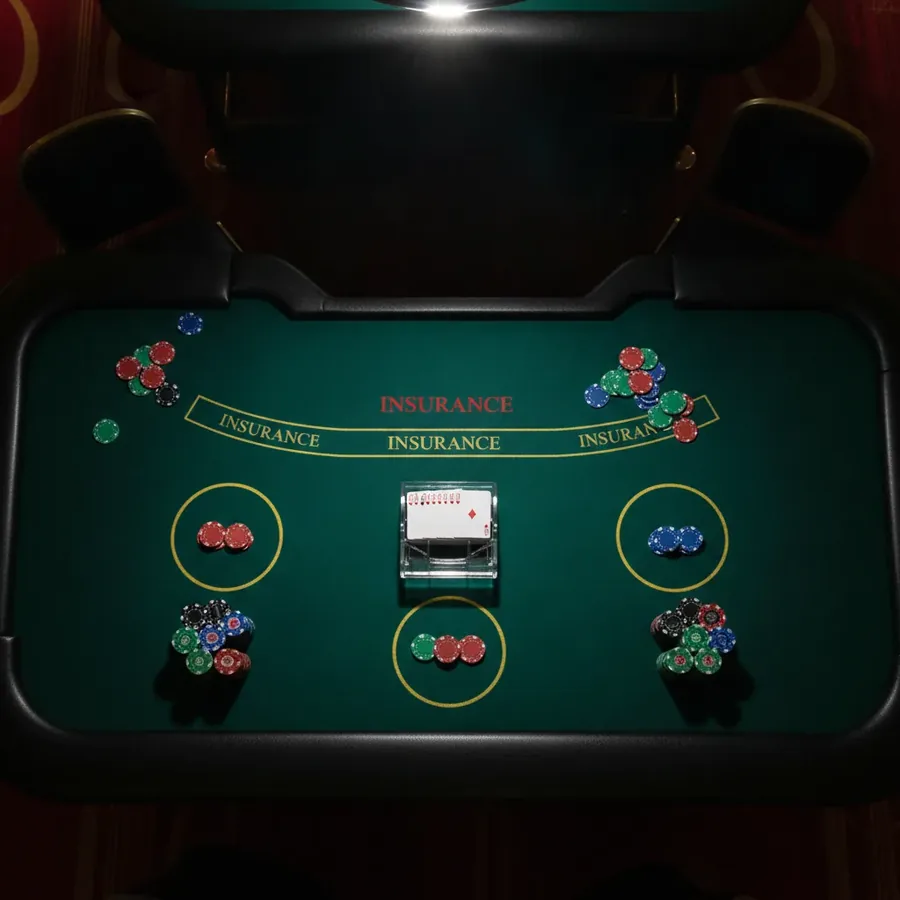
Insurance Pays 2:1 Yet Still Costs Money
The Insurance side bet offers a 2:1 payout when the dealer holds an Ace, allowing players to hedge against a potential dealer Blackjack. However, this separate wager carries a house edge of 7.47% across six to eight decks, which significantly drags down the overall return compared to standard play. This high cost means that accepting insurance reduces the theoretical return on investment for every hand played.
In contrast, the main Blackjack game with liberal Vegas Strip rules features a much lower house edge of 0.28%, making it a far more efficient use of funds. The Insurance bet’s negative expectation is so strong that basic strategy dictates always rejecting it unless the player is counting cards with a true count of +3 or higher. Accepting this bet without card counting guarantees a mathematical loss over time.
For a typical session, declining insurance preserves the base RTP of the primary game rather than diluting it with a high-margin side product. While the 2:1 odds appear attractive, the probability of the dealer having a ten-value card does not justify the risk relative to the house advantage. Players relying on basic strategy should view insurance as a costly error rather than a viable protective measure.
Seat change at the Live Table in 20 seconds
Quantum Blackjack Plus by Playtech allows bets ranging from 1 to 5,000 EUR, featuring quantum multipliers up to 1,000x on specific three-card combinations totaling 21 points. This high-limit table accommodates significant stakes while offering dynamic payouts that can drastically alter the outcome of a single hand through random multipliers. The game structure supports both casual players and high rollers seeking volatile wins.
Evolution’s Lightning Blackjack operates with a slightly lower stake range of 1 to 2,500 EUR but introduces lightning multipliers up to 25x on winning hands for unlimited players. This format provides a different volatility profile compared to the Playtech variant, focusing on frequent smaller multipliers rather than rare extreme ones. Both titles maintain an RTP near 99.56%, ensuring fair theoretical returns despite the added multiplier mechanics.
Infinite Blackjack from Evolution also accepts wagers between 1 and 5,000 EUR, distinguishing itself with four side bets including Any Pair, 21+3, Hot 3, and Bust It. The unlimited seating capacity ensures that players never face wait times, maintaining a continuous flow of action regardless of peak hours. This accessibility makes it a robust option for those preferring traditional blackjack mechanics enhanced by multiple betting opportunities.
Why Loss Progression Quickly Reaches Table Limit
A progressive betting system doubles the stake after each loss, meaning a starting bet of 1 EUR escalates rapidly to 128 EUR after just seven consecutive losses. Since the minimum bet at Quantum Blackjack Plus is 1 EUR and the maximum is 5,000 EUR, such progression consumes the allowable betting window in fewer than twelve hands. This mathematical reality limits the sustainability of any martingale-style strategy over extended sessions.
Even with a higher starting bankroll, the exponential growth of bets during a losing streak quickly outpaces typical player reserves. For instance, a sequence of ten losses on a doubling system requires a total exposure of 2,047 EUR just to recover the initial unit. Most tables impose hard caps that prevent recovery once the limit is reached, locking in the accumulated deficit permanently.
The house edge of 0.46% in standard blackjack ensures that long-term variance will eventually trigger these severe losing streaks for any player. Unlike slot machines where spins are independent, table games involve decision-making that cannot alter the underlying probability of the deck composition. Consequently, attempting to beat the house edge through bet sizing alone is mathematically futile.
Four hours of play with 300 EUR bankroll
Table games contribute only 10% toward the wagering requirements of the 300% welcome bonus up to 2,000 EUR, making them inefficient for clearing promotional funds. With a 300 EUR bankroll, playing four hours at a standard pace might involve approximately 1,200 hands if averaging one hand per minute. This volume translates to roughly 300 EUR in turnover if betting 0.25 EUR per hand, which counts as only 30 EUR toward bonus clearance.
In contrast, slots contribute 100% to the wagering requirement, meaning every euro wagered directly reduces the remaining obligation. A player using the same 300 EUR bankroll on slots could clear the bonus significantly faster due to the higher contribution rate and typically faster spin speed. Relying on blackjack variants like the 6-deck version with a 0.46% house edge yields minimal progress against the bonus terms.
The disparity in contribution percentages creates a strategic dilemma for players holding the welcome bonus who prefer table games. To meet the full wagering amount using only blackjack, a player would need to wager ten times more than on slots. This structural disadvantage effectively penalizes table game enthusiasts for choosing lower-house-edge options.
Bet two percent of bankroll per hand
Betting 2% of a 300 EUR bankroll results in a fixed stake of 6 EUR per hand, providing a buffer against short-term variance without risking rapid depletion. At this level, a losing streak of twenty hands reduces the bankroll by 120 EUR, leaving 180 EUR still available for continued play. This conservative approach aligns with professional bankroll management principles designed to extend session longevity.
Comparatively, betting the entire 300 EUR on a single hand exposes the player to immediate ruin upon a single loss, whereas the 2% rule allows for statistical recovery. The house edge of 0.46% on favorable blackjack rules means that expected loss per hour is manageable at this stake size. Consistency in bet sizing prevents emotional decision-making during inevitable downswings.
However, even disciplined betting cannot overcome the negative expectation inherent in casino games over the long term. If the player faces a 5% house edge variant, the expected hourly loss increases proportionally, eroding the 6 EUR stake faster than at 0.46%. Sustainable play requires selecting games with the lowest possible house edge to minimize the rate of bankroll decay.
Blackjack variants at a glance
| Variant | Payout | House edge | Rule | Bet range |
|---|---|---|---|---|
| Blackjack Ein Deck, klassische Regeln, 3:2 | 99.85% | 0.15% | Weniger Decks = niedrigerer Vorteil; ein Deck gibt ca. −0.48 Prozentpunkte gegenüber 8 Decks. Oft durch 6:5 Auszahlung kompensiert. | Blackjack 3:2, Gewinn 1:1 |
| Blackjack Insurance / Versicherung (6–8 Decks) | 92.53% | 7.47% | Separate Nebenwette bis 50% der Hauptwette, wenn der Dealer ein Ass hat. Basisstrategie schreibt IMMER Ablehnung vor (außer Karten zählen bei True Count ≥ +3). Bei einem Deck Vorteil ≈ 5.88% | Insurance 2:1 |
| Blackjack Surrender (Late Surrender) – Regel-Effekt | n.a. (Regel-Modifikator) | −0.08 Prozentpunkte | Spieler gibt Hand nach Dealer-Blackjack-Prüfung auf, verliert die Hälfte des Einsatzes. Verbessert RTP um ca. 0.08 Prozentpunkte. Early Surrender ist wesentlich wertvoller (bis −0.6 Prozentpunkte), aber extrem selten. | Rückzahlung 50% des Einsatzes |
| Blackjack 6 Decks, S17, DAS, DOA, Auszahlung 3:2, Basisstrategie | 99.54% | 0.46% | Dealer steht auf Soft 17; Verdopplung auf jeder Zweierkarte; Verdopplung nach Split erlaubt; keine Aufgabe. Basisstrategie ist für diesen Wert zwingend | Blackjack 3:2, normaler Gewinn 1:1, Insurance 2:1 |
| Blackjack Split / Double / H17 – Regel-Effekte | n.a. (Regel-Modifikatoren) | H17 +0.22 Prozentpunkte; RSA −0.08 Prozentpunkte; DAS −0.14 Prozentpunkte | Dealer Hits Soft 17 verschlechtert RTP um 0.22 Prozentpunkte; Resplit Aces verbessert um 0.08 Prozentpunkte; Double After Split verbessert um ca. 0.14 Prozentpunkte; 6 Decks statt 8 – ca. 0.02 Prozentpunkte. | Double – Einsatz ×2 mit einer Karte; Split – bis 4 Hände; Ass-Split meist mit einer Karte. |
| Blackjack Auszahlung 6:5 statt 3:2 (6 Decks) | 98.15% | 1.85% | Ersatz von 3:2 durch 6:5 fügt exakt +1.39 Prozentpunkte zum Vorteil des Casinos hinzu – stärker als jede andere Regeländerung. Bei $10 Einsatz zahlt Blackjack $12 statt $15. | Blackjack 6:5, Gewinn 1:1 |
Infinite Blackjack uses the Six Card Charlie
The Infinite Blackjack table by Evolution supports unlimited players and features side bets like Any Pair, 21+3, Hot 3, and Bust It, with a standard bet range from 1 to 5,000 EUR. This specific variant includes the Six Card Charlie rule, which automatically wins any hand containing six cards without busting, effectively altering the standard probability calculations for extended sequences. Players benefit from this structural advantage as it reduces the house edge on multi-card hands compared to traditional rules that require strict twenty-one totals. The RTP remains stable at 99.47% when optimal strategy is applied across all available betting options and side wager combinations.
Evolution provides Infinite Blackjack with a maximum stake limit of 5,000 EUR, allowing high rollers to place substantial wagers against the dealer without physical seat constraints. The game integrates four distinct side bets, each offering unique payout structures that diverge significantly from the main blackjack outcome probabilities. Participants must evaluate these additional wagers carefully, as they carry higher house edges than the primary game but provide frequent small returns on pair or total outcomes. The interface displays real-time card counts to help players track deck penetration and adjust their strategic decisions accordingly during live sessions.
When does the table max bet apply?
The Quantum Blackjack Plus Live table operated by Playtech enforces a strict maximum bet limit of 5,000 EUR per round, capping potential exposure for both the operator and the participant. This financial boundary ensures that even if quantum multipliers reach their theoretical peak of 1,000x on three-card twenty-one combinations, the absolute payout remains within predefined operational thresholds. Players engaging with high-stakes strategies must verify their account balance against this ceiling before initiating any wagering sequence or adjusting bet sizes dynamically. The restriction applies uniformly across all game rounds regardless of current multiplier activations or special feature triggers during the live broadcast stream.
Which hands are excluded from Surrender?
Late Surrender in Blackjack allows players to forfeit half their bet after the dealer checks for an immediate blackjack, improving the Return to Player rate by approximately 0.08 percentage points. This option is strictly unavailable if the dealer holds a natural twenty-one, meaning the player loses the entire stake immediately without the opportunity to mitigate losses through partial surrender. Early Surrender, which permits giving up before the dealer inspection, offers greater value up to 0.6 percentage points but is extremely rare in modern online casino environments. Standard Liberal Vegas Strip rules typically include Late Surrender alongside other favorable conditions like resplitting aces and doubling after splits for optimal strategic flexibility.
One Deck vs Eight Decks in House Edge
One-Deck Blackjack offers a superior Return to Player of 99.85% with a minimal house edge of just 0.15%, primarily because fewer cards reduce the statistical probability of unfavorable dealer outcomes. Using only one deck provides roughly a 0.48 percentage point advantage over eight-deck variations, making it the most mathematically efficient format for skilled players utilizing perfect basic strategy. However, casinos often compensate for this mathematical disparity by reducing standard blackjack payouts from 3:2 to 6:5, which dramatically increases the house edge to 1.85%. Players must scrutinize payout tables closely, as a single deck with reduced payouts yields worse long-term results than multiple decks paying full 3:2 ratios.
Check table limit before the first bet
Lightning Blackjack by Evolution imposes a maximum bet cap of 2,500 EUR per hand, limiting the total potential win from lightning multipliers that can reach up to 25x on victorious rounds. This upper bound restricts high-roller activity compared to other variants like Infinite Blackjack, which allows stakes up to 5,000 EUR without such severe concentration limits on individual transactions. Participants should calculate their desired exposure against this specific threshold to ensure their bankroll management aligns with the platform's risk parameters and maximum allowable wagers. The limited player capacity also influences pacing, requiring faster decision-making to accommodate the continuous flow of new hands and multiplier applications.
Stand-on-17 Rule and Its Meaning for Players
The Dealer Hits Soft 17 rule negatively impacts the game by increasing the house edge by exactly 0.22 percentage points compared to standing on soft seventeen. This specific modifier reduces the theoretical return to player, making the standard Soft 17 variation significantly more favorable for long-term bankroll preservation than its hitting counterpart.
The Liberal Vegas Strip variant offers a superior RTP of 99.72% with a house edge of just 0.28%, representing one of the most generous rule sets available in online blackjack environments. This combination includes standing on soft 17 plus additional liberal rules like resplitting aces and late surrender, which collectively minimize the casino's mathematical advantage over the participant.
Adhering strictly to basic strategy is mandatory to achieve the optimal 99.54% RTP associated with six-deck games featuring stand-on-soft-17 conditions, as any deviation increases the inherent house edge substantially. Players must follow precise decision matrices for every hand to ensure they do not surrender expected value that would otherwise be preserved through correct statistical play at the table.
Infinite Blackjack vs Classic Seven-Seat Table
Infinite Blackjack by Evolution allows an unlimited number of players to join the table simultaneously, contrasting sharply with classic seven-seat restrictions found in traditional land-based or older digital implementations. This format supports bets ranging from 1 EUR to 5,000 EUR while maintaining a high RTP of 99.47%, ensuring fair odds regardless of how many participants occupy the virtual seats during peak hours.
Quantum Blackjack Plus Live, provided by Playtech, introduces Quantum Multipliers up to 1,000x on three-card combinations totaling 21 points, offering massive payout potential beyond standard winning hands. With a betting range of 1 to 5,000 EUR and an RTP of 99.57%, this title transforms routine gameplay into high-variance events where side bet outcomes can drastically alter session results significantly.
Lightning Blackjack by Evolution features Lightning Multipliers reaching up to 25x on winning hands, providing frequent smaller boosts rather than the extreme highs seen in quantum versions. Operating with an RTP of 99.56% and limits between 1 and 2,500 EUR, this game balances entertainment value with reasonable volatility, appealing to players who prefer consistent returns over rare jackpot scenarios.
Split, Double Down, and Surrender in Numbers
Resplitting Aces (RSA) improves the player's position by reducing the house edge by 0.08 percentage points, allowing multiple splits of aces for enhanced strategic flexibility during difficult dealing scenarios. This rule modification positively influences the overall RTP, making games offering RSA statistically preferable to those restricting players to a single split per pair of aces under identical base conditions.
Double After Split (DAS) further decreases the house edge by approximately 0.14 percentage points, permitting players to double their initial wager on any card received after splitting pairs. This aggressive maneuver significantly boosts potential profits on strong hands, contributing to a lower overall house edge when combined with other favorable rules like early surrender availability.
Late Surrender allows players to forfeit half their bet after the dealer checks for blackjack, effectively reducing the house edge by 0.08 percentage points in losing situations. This safety net protects bankrolls against inevitable losses, particularly when holding weak totals against strong dealer upcards, thereby extending playing time and preserving capital for future advantageous opportunities at the table.
How many decks are in the shoe?
Single-deck blackjack games offer the lowest house edge of 0.15% with an RTP of 99.85%, primarily because fewer cards reduce the probability of drawing unfavorable values during play. This mathematical advantage is substantial, though often counteracted by casinos implementing restrictive rules like the 6:5 payout structure, which neutralizes the benefit gained from using a single deck versus multiple decks.
Six-deck shoes are common in online variants, presenting a house edge of 0.46% and an RTP of 99.54% when paired with favorable rules like standing on soft 17. The slight increase in complexity compared to single-deck games is manageable for basic strategy users, providing a balanced experience that maintains high return rates without requiring advanced counting techniques for optimal play.
Eight-deck games typically carry a higher baseline house edge due to increased penetration depth, yet they remain popular for their stability and resistance to card counting strategies employed by skilled participants. The transition from one deck to eight decks generally adds roughly 0.48 percentage points to the house advantage, necessitating stricter adherence to basic strategy to mitigate the impact of larger shoe sizes on long-term expectations.
Side Bet Every Round: Budget Lasts 30 Rounds
Blackjack Insurance carries a severe house edge of 7.47% and an RTP of only 92.53%, making it a highly unfavorable proposition for regular players seeking positive expectation outcomes. Basic strategy explicitly advises rejecting insurance unless specific card-counting conditions apply, such as a true count of +3 or higher, where the mathematical expectation shifts slightly in favor of the participant.
The contribution of table games like blackjack toward bonus wagering requirements is limited to just 10%, whereas slots contribute 100%, forcing players to allocate significant portions of their bankroll elsewhere. With a 300% welcome bonus up to €2,000, focusing solely on blackjack makes fulfilling the turnover obligation extremely difficult due to the low contribution rate, requiring much higher total wagers to clear the bonus funds effectively.
Infinite Blackjack includes four side bets including Any Pair, 21+3, Hot 3, and Bust It, each carrying distinct risk profiles that vary widely from the main game's RTP of 99.47%. These optional wagers allow players to customize their volatility, but they also dilute overall returns if played excessively, as the primary objective should remain maximizing the base game's potential through disciplined betting patterns and strategic decisions.
Contact
Live - online chat
Banking



Providers





Golden Bull Casino 2026